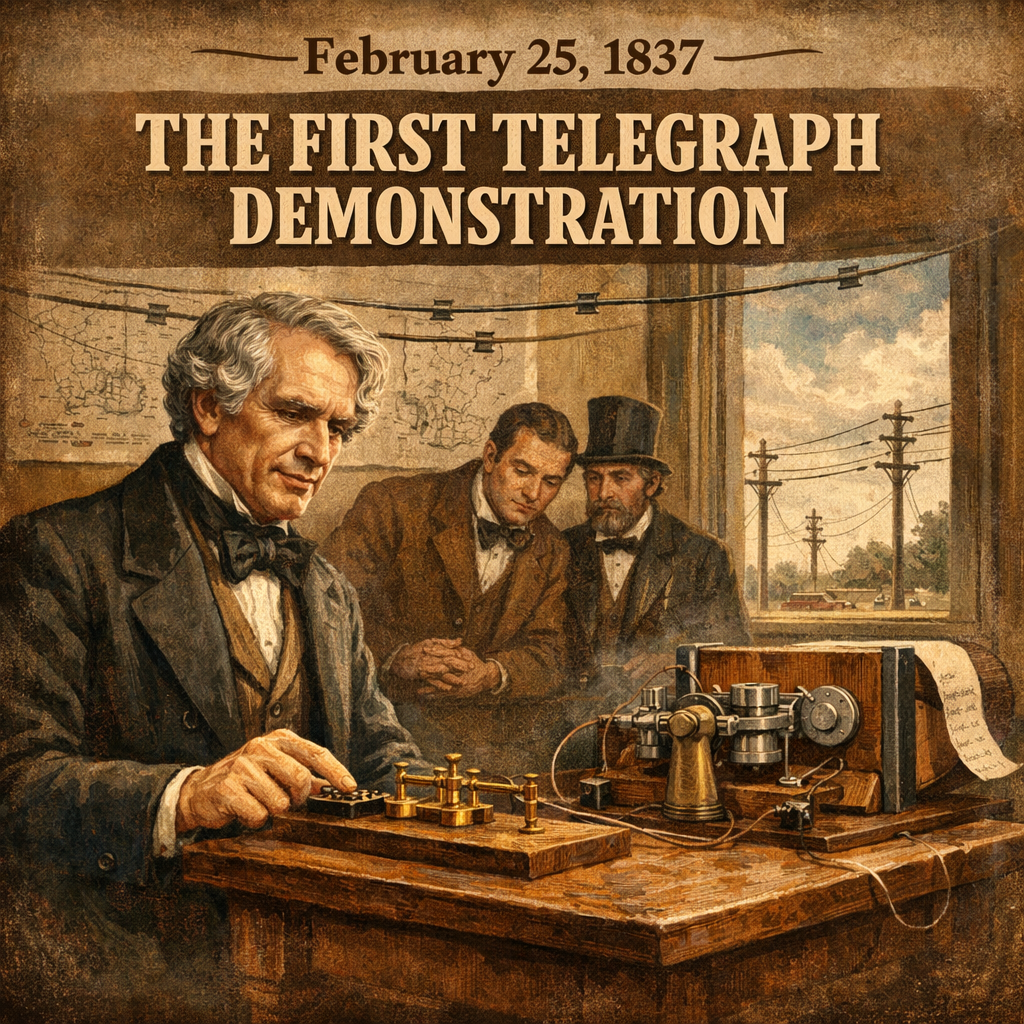
On February 25, 1837, Samuel Morse publicly demonstrated a device that would change communication forever. For the first time, a message could travel instantly through a wire instead of by horse, ship, or train.
It is difficult to imagine the world before that moment. News moved slowly. A letter from New York to Washington could take days. Information about markets, elections, disasters, or family emergencies traveled at the speed of transportation.
Morse’s invention changed the speed of information from miles per hour to nearly the speed of electricity.
How the Telegraph Worked
The system was simple but revolutionary. An operator tapped a key, sending electrical pulses through a wire to a receiver at the other end. Those pulses were translated into a pattern of short and long signals.
That pattern became known as Morse Code.
With practice, operators could send and receive full messages using nothing more than a series of clicks.
No paper. No envelopes. No waiting.
Just information moving instantly across distance.
Why This Moment Mattered
The telegraph did more than speed up communication. It reshaped how the country operated.
Within a few decades:
- Railroads used telegraph lines to prevent collisions and manage schedules
- Newspapers received reports from distant cities the same day events happened
- Businesses tracked prices and made decisions faster
- Families could send urgent news across states in minutes
For the first time in history, distance was no longer the main barrier to communication.
The United States began to feel smaller and more connected.
The First Message
Seven years after that early demonstration, Morse completed the first long-distance telegraph line between Washington, D.C., and Baltimore. On May 24, 1844, the first official message was sent:
“What hath God wrought.”
The words came from the Bible (Numbers 23:23) and captured the sense that something entirely new had entered the world.
The Beginning of the Information Age
The telegraph did not just improve communication. It created a new way of thinking about information.
For the first time:
- News became immediate
- Markets began reacting in real time
- National conversations could happen across long distances
- Technology, not transportation, determined the speed of communication
In many ways, the telegraph was the internet of the 19th century. It laid the foundation for the telephone, radio, television, and eventually digital networks.
Every message sent today—email, text, or data—follows the same basic idea first proven in demonstrations like the one on February 25, 1837.
A Turning Point Worth Remembering
The demonstration of the telegraph did not look dramatic. There were no crowds or celebrations. Just wires, a key, and electrical signals moving from one place to another.
But that quiet experiment marked the beginning of instant communication.
It was the moment the world began moving at the speed of electricity.
Leave a Reply